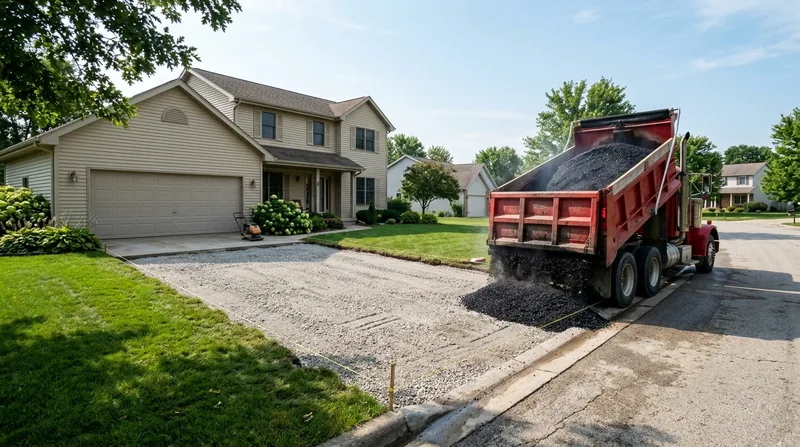




When driveway replacement becomes necessary in Springfield, the decision usually arrives after years of freeze-thaw damage, alligator cracking, or base failure that no patch can fix. The prairie clay beneath Springfield's older neighborhoods, combined with 39 inches of annual rain and dozens of winter freeze-thaw cycles, works asphalt hard. Sections of Washington Park, Harvard Park, and the Iles Park blocks carry driveways from the 1950s and 1960s that have reached the end of their 20-to-30-year service life. The newer subdivision stock on the southwest side from Westchester to Panther Creek and across to Chatham and Rochester, built in the 1980s through 2010s, is aging into the same failure window now. When extensive alligator cracking runs section to section across the surface, the base underneath is gone, and no overlay will save it. We remove the old drive, rebuild the crushed limestone base over the prairie clay, and pave a binder-plus-surface structure that restarts the clock, honestly quoted against the repair option and backed by written estimates with tonnage specs.
Why Driveway Replacement Becomes Necessary in Springfield
Driveways in Springfield fail for three main reasons: base erosion from the clay and water table beneath, surface fatigue from salt and plow damage over ten-plus winters, and the cumulative stress of freeze-thaw cycling. When cracks begin to interconnect in a web pattern, water has already penetrated to the base, and the asphalt is no longer a monolithic surface but a collection of failing pieces. At that point, patching or even resurfacing throws money away because the foundation is compromised. The decision to replace rather than repair comes down to the percentage of the surface that has failed and the depth of the damage underneath.
- Alligator cracking across 30 to 40 percent or more of the surface signals that base reconstruction, not overlay, is the right move.
- Subsidence or settlement in the mining belt south of Springfield (Riverton, Divernon, Auburn, Virden) can crack and heave pavement, making replacement necessary sooner than in non-mining areas.
- Potholes that return in the same spot within one season indicate base failure and justify full-depth removal and replacement.
- Upheaval or buckling along the edges, common after heavy freeze-thaw winters, signals that the base has lost bearing and the asphalt has separated from its foundation.
- Extensive edge deterioration from road salt and plow damage, especially on the north and east sides where older worker cottages and 1950s ranches sit on narrow drives, often makes the entire perimeter unusable before the center fails.
Once the base is compromised, repair costs accumulate quickly, and a full replacement becomes the economical choice. We help homeowners understand when they have reached that threshold.
Key info: In Springfield neighborhoods like Aristocracy Hill and Enos Park, where 1850s brick homes sit on tight grid lots with 20-foot side driveways, base failure often appears first at the alley apron or the transition to the street. In the newer subdivisions of Rochester and Sherman, where two-car drives run 30 to 40 feet, failure is often concentrated at the top (where water pools) or the bottom (where weight concentrates). Identifying the failure pattern helps us recommend the right fix.
For more detail on the repair-versus-replacement decision, see our page on asphalt resurfacing and overlay, which explains when an overlay holds and when the money belongs in full replacement.
How Driveway Replacement Works: Our Process in Springfield
Full driveway replacement in Springfield follows a sequence: we measure and mark the drive, coordinate with Illinois 811 for utility locates (required by law before any excavation), remove the old asphalt and failed base, grade and compact the subgrade, install new crushed limestone base in 4 to 6 inches, proof-roll for compaction, and pave the new asphalt in two lifts, binder course plus finished surface. The entire job takes 3 to 5 working days for a typical residential drive, weather permitting. Hot mix asphalt runs April through November in Springfield, so we schedule replacement during the paving season and build the timeline into the estimate.
- We remove the old asphalt and haul it off-site or recycle it into RAP (recycled asphalt pavement) for future projects.
- We excavate and remove failed base material, often 4 to 8 inches of weakened limestone and clay, until we reach stable subgrade.
- We grade the subgrade to proper slope (typically 2 percent cross-slope for drainage) so water runs to the street, not into the yard or foundation.
- We install new crushed limestone base, compacted in lifts, sized and graded to spec for bearing capacity under residential loads.
- We proof-roll the base with heavy equipment to confirm compaction before paving begins.
- We pave the new asphalt in two lifts: a binder course (usually 1.5 inches) and a finish course (usually 1.5 to 2 inches), both compacted hot.
- We set the drive to the correct elevation so it ties cleanly to the street apron and existing sidewalk or lawn without creating a lip or a low spot.
The entire process is built around drainage, compaction, and proper thickness so the new drive performs for two to three decades before the next major work is needed.
Local example: A 1960s ranch in Leland Grove with a 20-by-50-foot drive that had alligator cracking from the street apron to the garage required full removal and base replacement. The old base was 2 inches of deteriorated limestone over clay that had settled 1/2 inch. We removed 6 inches total, installed 5 inches of new compacted limestone base, and paved 3.5 inches of new asphalt. The job took 4 working days and cost less than three more years of patching would have.
For more on our approach to base preparation and grading, see gravel driveway installation and grading, which covers the foundation principles that underpin all our paving work.
Driveway Replacement Methods and Materials
| Approach | Description | Best For |
|---|---|---|
| Full-depth replacement with new asphalt | Remove old asphalt and failed base, install new crushed limestone base 4 to 6 inches, pave new binder and surface course. | Alligator cracking, base failure, extensive settlement, or when the drive is more than 25 years old and multiple repairs have been needed. |
| Milling and overlay | Remove top 1.5 to 2 inches of old asphalt with a mill machine, recycle the milled material, and pave a new surface course over the remaining base. | Surface wear and cracking only, when the base is still sound and the subgrade has not settled or failed. |
| Recycled asphalt millings driveway | Grade and compact the subgrade, apply layers of recycled asphalt (RAP) mixed with new binder, compact and finish. | Budget-conscious homeowners, rural or farm drives, or temporary surfaces that can be re-dressed annually in spring. |
| Tar and chip surface | Spray a layer of hot liquid asphalt binder onto a compacted base, then broadcast stone chips and roll them in for a rustic appearance. | Rural or estate drives where a softer, unsealed surface is acceptable and cost is a factor. |
Each method has a cost, a lifespan, and a best-fit scenario. Full-depth replacement with new asphalt is the standard for residential driveways in Springfield because it restarts the 20-to-30-year clock and handles the freeze-thaw and water-table stress of the prairie climate. We help you choose the right option based on what has failed and what you need the drive to do.
Driveway Replacement Cost in Springfield: What to Expect
Full-depth driveway replacement in Springfield typically starts at $7 per square foot and can reach $10 to $12 per square foot depending on site conditions, base preparation, and local disposal costs. A typical 20-by-50-foot residential drive (1,000 square feet) runs $7,000 to $12,000 for full removal, base replacement, and new asphalt. The cost per square foot moves upward if the subgrade requires significant grading or if failed base material is deeper than expected, and it can move downward if multiple drives are done back-to-back in the same neighborhood (which sometimes happens in subdivisions where the vintage cohort is all aging together, as in the southwest growth corridor or in Chatham and Rochester).
Factors that affect the final cost include:
- Depth of failed base and the amount of material that must be removed and hauled away.
- Slope and drainage work needed to ensure water runs away from the foundation and garage.
- Access for equipment: tight drives on the north side near Eastside or narrow grid-lot drives in Aristocracy Hill cost more because the excavator and paving truck have limited room to work.
- Utility locates and any conflicts with gas, electric, or water lines that require coordination or hand work.
- Apron work: if the street apron must be rebuilt to match the new drive elevation, that is additional cost.
- Timing: jobs scheduled during peak season (May to September) may have slightly longer lead times than shoulder-season work.
We provide a written estimate with the square footage measured on-site, the base thickness and tonnage specified, and the total cost broken down by phase. The estimate is free and carries no obligation. To get a precise number for your drive, call (447) 226-1294 or visit our pricing page for more detail on how we calculate replacement work.
Comparison note: Driveway replacement is more expensive than repair or resurfacing because it includes full excavation, base rebuilding, and new asphalt. However, if the base is gone, overlay or patching will fail within one to two years, making replacement the economical choice over the long term. We always recommend getting 2 to 3 estimates so you can compare scope, pricing, and the contractor's honesty about whether replacement is truly necessary.
Driveway Replacement Near Me: What Springfield Homeowners Should Know Before Hiring
Choosing a paving contractor for driveway replacement is a major decision because the work is visible, expensive, and long-lived. Springfield homeowners should verify a few key points before signing a contract. First, ask any contractor for proof of insurance and request a certificate of liability coverage; we carry full insurance and can provide that documentation immediately. Second, get a written estimate that includes the square footage measured on-site, the base thickness and tonnage, the asphalt thickness, and the total cost. Third, ask whether the contractor is registered or licensed with the City of Springfield or your specific village (licensing requirements vary by municipality within our service area), and verify that claim directly with your city or village building department. Fourth, check references from jobs done in Springfield or nearby towns where you can see the work and speak with the homeowner about the contractor's communication and cleanup.
Additional considerations for Springfield homeowners:
- Ask your village or city whether a permit is required for driveway replacement and whether there are restrictions on impervious surface, stormwater, or curb cuts in your neighborhood.
- If your home is in a master-planned community or HOA (common in Panther Creek, Legacy Pointe, and many of the newer subdivisions), verify that asphalt is approved and that the driveway dimensions comply with architectural guidelines.
- Ask the contractor to confirm that Illinois 811 utility locates will be called before excavation begins, as required by law.
- Understand the timeline: full replacement typically takes 3 to 5 working days, and the asphalt must cure before heavy use (typically 48 hours in good weather, longer in cool or wet conditions).
- Avoid contractors who solicit door-to-door, offer a price with no written estimate, demand a large cash deposit upfront, or claim to have leftover asphalt from a nearby job. These are classic warning signs in the paving trade.
We are based in Springfield, fully insured, and have been in business since 2011. We provide free estimates with no obligation, and we are happy to answer questions about our process and credentials. Contact us at (447) 226-1294 or through our contact page to schedule your free estimate and discuss whether replacement is the right choice for your drive.
When to Replace vs. When to Repair or Resurface
Not every failing driveway needs replacement. If the base is still sound and the cracking is limited to the top 1 to 2 inches of asphalt, repair or patching can extend the life by 3 to 5 years and cost a fraction of replacement. If the surface is worn but the base is intact and only light cracking is visible, resurfacing or overlay can add 10 to 15 years for roughly 30 to 40 percent of the cost of full replacement. Replacement becomes the right call when alligator cracking runs across 30 to 40 percent or more of the surface, when the base has failed and patches return within one season, or when the drive is more than 25 years old and has required multiple repairs. We help homeowners make that assessment honestly, because recommending unnecessary replacement is not how we build trust in Springfield.
Driveway Replacement in Springfield: Pricing Guide
| Service | Price | Details |
|---|---|---|
| Full-depth replacement, residential drive | Starting at $7/sq ft | Includes excavation, new limestone base 4 to 6 inches, new asphalt binder and surface course, site cleanup |
| Additional cost per square foot for difficult access or deep base failure | $9 to $12/sq ft | Tight drives, extensive grading, subgrade settlement, or utility coordination can increase cost above base rate |
| Apron or transition work | On estimate | Rebuilding street apron or adjusting elevation to match new drive requires site measurement and coordination with city |
| Disposal and recycling of old asphalt | Included | Old asphalt is removed, hauled off-site, and recycled into future projects; no separate charge to homeowner |
| Free estimate with written specs | No charge | Square footage, base thickness, tonnage, and total cost provided in writing within 24 hours, no obligation to book |
Indicative pricing, the exact cost depends on square footage, finish, and site access. Free personalized estimate within 24h at (447) 226-1294.


