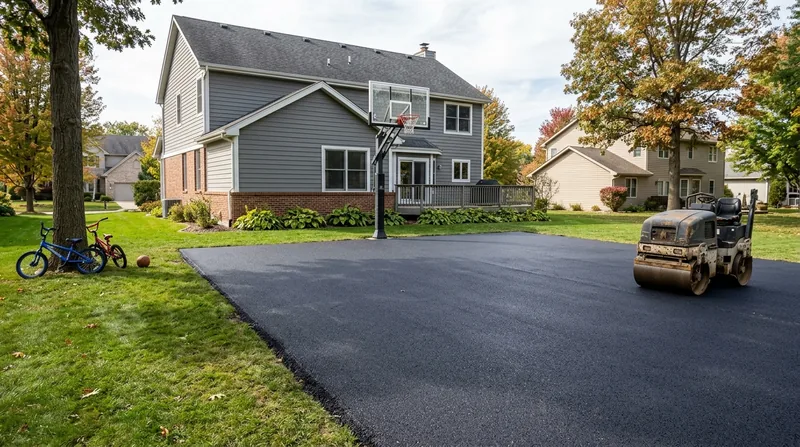




Springfield's mix of tight historic neighborhoods, 1950s worker cottages, and sprawling modern subdivisions creates unique opportunities for recreational surfaces that stand up to the region's freeze-thaw cycles. Whether you're installing a backyard basketball court in the tree-lined blocks near Washington Park, a tennis base in one of the newer developments off Chatham Road, or a walking path on a private estate south of Lake Springfield, Sports Court & Path Paving in Springfield demands precision flatness, tight tolerances, and a structural foundation that won't heave or crack when winter temperatures swing 40 degrees in a single week. We build asphalt courts and paths dead-flat with the surface courses ready for acrylic color systems, and we engineer the base and drainage to keep your court true through decades of freeze-thaw and heavy use.
Why Sports Court & Path Paving Matters in Springfield's Climate
Central Illinois gets roughly 39 inches of rain a year, and the freeze-thaw cycle runs October through April, with dozens of temperature swings that pop pavement and shift foundations. A basketball court or tennis base that's off-plane by even a quarter inch becomes a drainage liability and a play hazard. The deep prairie loess and glacial till clay under Springfield's soil holds water aggressively after rain, which means improper grading under a court will heave the surface in winter and create standing water in spring. A properly built asphalt court sits on a compacted stone base with correct slope and subsurface drainage, so water moves away from the playing surface instead of collecting beneath it.
- We excavate to proper depth, remove soft material, and compact a stone base that sheds water away from the court.
- We set asphalt surface courses with tight tolerances so acrylic paint systems adhere evenly and the ball rolls true.
- We slope the court correctly to drain toward perimeter swales or to your existing drainage system.
- We build the structure thick enough that freeze-thaw heave stays minimal and the court holds its shape for 15 to 20 years.
A court built to these standards survives Springfield winters without cracking, settling, or creating water traps that damage the acrylic finish.
Key info: Springfield's freeze-thaw cycles and heavy clay soil are the primary threats to court longevity. Many DIY or budget installs skip proper base preparation and drainage, then fail within three to five years when water gets under the surface. We start with the base, not the top coat.
For more on how we handle demanding subsurface conditions, see our work on Gravel Driveway Installation & Grading, where base preparation and drainage are equally critical.
How We Build a Court or Path: The Springfield Standard
A sports court or walking path starts with a site survey and a clear understanding of your slope, drainage, and what surface you want to paint or finish. We measure the area, mark the perimeter, and calculate the base depth needed given Springfield's soil and your local water table. From there, we excavate, grade, compact, set stone, proof-roll, and pave in layers designed to last.
- We survey the site, check for utilities using Illinois 811, and mark the court footprint with correct slope.
- We excavate soft material and clay, removing all organic matter and unstable soil down to firm bearing.
- We compact a stone base in lifts, proof-roll it to verify stability, and set perimeter drainage or swales.
- We lay a binder course of asphalt, then a smooth surface course, finished to dead-flat with tight tolerances for paint adhesion.
- We allow the asphalt to cure for six to twelve months before any acrylic color system is applied.
The result is a court that stays flat, drains properly, and holds paint and line markings for years.
Example: A residential tennis court in the Iles Park area of Springfield required removal of mature oak root systems and regrading to prevent water from flowing toward the home's foundation. We excavated the roots, compacted a 12-inch stone base with proper slope away from the house, and paved a 4-inch asphalt court that has remained flat and crack-free through four winters. The homeowner painted it acrylic green and installed a practice wall on one end.
For details on how we manage difficult grading and subsurface work, visit our main paving page or call us at (447) 226-1294 for a site consultation.
Sports Court and Path Paving Methods
| Method | Description | Best For |
|---|---|---|
| Full-depth asphalt court | Excavate to 24 to 36 inches, compact stone base, set binder and surface courses, finish dead-flat for acrylic paint. | New residential tennis, basketball, or pickleball courts; golf cart paths; walking trails on sloped or poorly drained sites. |
| Overlay on existing asphalt | Mill the top 1 to 2 inches, reset base if needed, lay new surface course to correct slope and flatness. | Refreshing an older court or path when the base is still sound and drainage is acceptable. |
| Sloped walking path | Compact stone, set 2 to 3 inches of asphalt with controlled slope to shed water to swales or drainage. | Hillside or sloped terrain; connecting a house to a garage, barn, or lake; golf cart access roads. |
| Tight-tolerance court surface | Laser-graded asphalt finish within 1/8 inch of target elevation; ready for acrylic color and line marking. | Any court intended for acrylic paint; professional or semi-professional play surfaces; HOA or institutional courts. |
Sports Court and Path Paving Cost in Springfield: What to Expect
A residential basketball or tennis court in Springfield typically starts at $8,500 for a 2,000 to 2,500 square foot area with standard base preparation, single-layer asphalt, and a flat finish ready for paint. Costs move up if the site requires extensive excavation, poor soil removal, complex drainage, or if you want a thicker or multi-course structure. A walking path or golf cart trail runs lower per square foot but depends on length, slope, and whether the ground is already compacted. The best way to get a real number is a site visit where we measure, check your soil and drainage, and give you a written estimate with tonnage and thickness specified.
- Site conditions (soil type, water table, existing pavement) are the largest variable in court cost.
- Size and shape matter: a 2,500 square foot court costs less per square foot than a 1,500 square foot court because setup and equipment are spread over more area.
- Acrylic paint, line marking, and any special finishes are separate from the asphalt cost and are handled by a paint contractor after cure.
- We include travel within Springfield and the surrounding service area; no mileage surcharge or call-out fee.
For a detailed pricing breakdown and to schedule a free estimate, visit our pricing page or call (447) 226-1294. We respond within 24 hours.
Sports Court and Path Paving Near Me: What Springfield Homeowners Should Know When Hiring
Finding a contractor to build a court or path that will actually last requires checking three things: insurance, references, and a clear understanding of what you are paying for. Any contractor you hire should carry general liability and workers compensation insurance and be able to show you a current certificate. Ask for references from courts or paths they built in Springfield or nearby towns, and call those homeowners to ask how the surface has held up through winter and whether the drainage works. Get written estimates from at least two contractors that specify the depth of stone base, the asphalt thickness, the total tonnage, and the slope. If a quote is vague about base depth or tonnage, that contractor is cutting corners.
- Ask any contractor to show you proof of insurance before work begins, and verify coverage limits with your local insurance agent.
- Request references from at least two residential court or path jobs completed in the last three years in Springfield or Chatham or Rochester.
- Get a written estimate that includes base depth, asphalt thickness, tonnage, and slope, so you can compare apples to apples.
- Check whether your village or township requires a permit for the court or path; if so, confirm that your contractor will help you navigate the permitting process.
- If your property is in an HOA, verify that the court material and color are approved before construction begins.
We are fully insured and have been building driveways and outdoor surfaces in Springfield and the surrounding area since 2011. For a free, no-obligation estimate and to discuss your court or path project, contact us here or call (447) 226-1294.
Sports Court & Path Paving in Springfield: Pricing Guide
| Service | Price | Details |
|---|---|---|
| Residential basketball or tennis court | Starting at $8,500 | 2,000 to 2,500 square feet with stone base, asphalt, and flat finish ready for paint |
| Walking path or golf cart trail | Starting at $6,000 | Per 500 linear feet; cost varies by width, slope, and soil conditions requiring base work |
| Pickleball or multi-sport court | Starting at $7,500 | 1,500 to 2,000 square feet; smaller footprint than tennis, same base and surface standards |
| Complex site with poor drainage or excavation | On estimate | Sites with high water table, clay removal, or extensive grading require site visit and soil assessment |
| Travel and estimate | Included and free | No mileage fee within Springfield and service areas; response within 24 hours at (447) 226-1294 |
Indicative pricing, the exact cost depends on square footage, finish, and site access. Free personalized estimate within 24h at (447) 226-1294.


