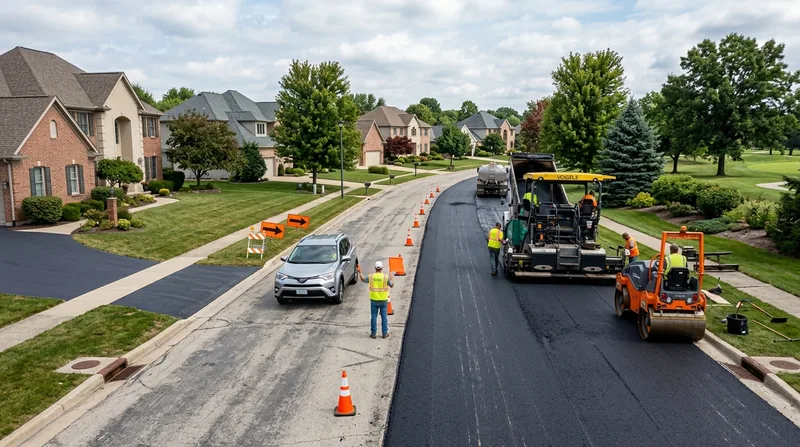




Private Road & HOA Paving in Springfield is the work that most driveway contractors turn down. A single residential drive sits on a lot; a private road or HOA street runs through a neighborhood, connects townhomes, or serves an apartment complex. The linear footage is long, the stakeholders are many, the scheduling is tight around residents who cannot have their street torn up without notice, and the paperwork is heavy. Springfield's suburban growth from the 1980s onward has filled the north, east, and southwest with master-planned communities whose private lanes and cul-de-sacs are now aging past their first surface life. The freeze-thaw cycles that dominate this central Illinois climate, the clay-heavy base that holds water after 39 inches of annual rain, and decades of salt and plow wear have left many of these streets with alligator cracking, edge failure, and potholes that affect dozens of homes at once. We handle the full scope: overlay and resurfacing to extend life, full-depth replacement where the base is gone, scheduling and phasing around occupied units, board-ready documentation, and reserve-study-friendly pricing that spreads cost across a multi-year plan.
Why Private Road & HOA Paving Matters in Springfield's Aging Subdivisions
The southwest growth corridor from Westchester to Panther Creek and Legacy Pointe, plus the suburbs of Chatham, Sherman, and Rochester, holds thousands of townhomes and apartment complexes built between 1980 and 2010. Those private roads were paved once, usually with a modest base and 2 to 2.5 inches of asphalt. Thirty to forty years later, the surface is failing. Unlike a single driveway, a failed private road affects the entire community: residents cannot park safely, emergency access is compromised, property values stall, and insurance claims pile up. An HOA board faces a choice: patch the potholes year after year, or invest in a permanent fix that protects the reserve fund and the neighborhood for another decade or more.
- Overlay and resurfacing add a new wearing course to roads that still have a sound base, extending pavement life 10 to 15 years at a fraction of replacement cost.
- Full-depth replacement removes failed pavement and base down to subgrade, rebuilds with proper stone and compaction, and installs new asphalt when the base is too damaged to salvage.
- Phased scheduling spreads work across seasons so residents maintain normal access, parking, and mail delivery during construction.
- Board documentation includes written estimates with tonnage specifications, scope drawings, and timeline so the HOA can present the project to owners and lenders with confidence.
- Reserve-study pricing aligns the cost schedule to the HOA's financial planning and lets boards fund the work without special assessments.
A private road or HOA street is a shared asset that requires professional engineering, planning, and execution. Treating it as a series of patch jobs costs more in the long run and defers the real problem.
Key info: Springfield's municipal code and the codes of Chatham, Sherman, Rochester, and other villages in the service area govern driveway aprons, culverts, curb cuts, and impervious-surface limits. HOA architectural standards also control material and appearance. We help navigate those rules, but the HOA board and the local building department always have final say. Verify permitting requirements with your village before any project begins. See the contact page to discuss your specific situation.
How We Plan and Execute Private Road & HOA Paving Projects
A private road project begins with a site visit, measurement, and a walk-through with the HOA board or property manager. We document the current condition, identify problem areas, measure linear footage and width, and assess the base. From that visit, we prepare a written estimate with tonnage specifications, a scope of work, and a realistic timeline. We then schedule the work in phases if needed, coordinate with the HOA to minimize disruption, and execute with full equipment and crew on site. The result is a board-ready package that shows what was done, how much it cost, and what the road will look like for the next decade.
- We meet with the HOA board or property manager to walk the road, assess pavement condition, and identify whether overlay, mill-and-overlay, or full-depth replacement is the right call.
- We measure the entire length and width, note drainage and grading issues, and document base condition through visual inspection and core sampling if needed.
- We prepare a written estimate with tonnage, thickness, equipment list, and a phased schedule that keeps the road open to residents during work.
- We coordinate with the municipality to confirm permit requirements and obtain any curb cuts or utility locates required by Illinois 811 law.
- We schedule work during the April-through-November paving season when weather allows proper compaction and curing.
- We execute with full crew and equipment, traffic control, and daily cleanup so residents see professional work from start to finish.
- We provide final documentation: as-built photos, tonnage records, and a maintenance schedule so the HOA knows what to expect in the years ahead.
The goal is a seamless project that the board can present to owners as a smart investment, not a crisis response.
Local example: A 12-unit townhome complex in Springfield's Washington Park area had a 400-foot private drive with alligator cracking and three potholes. The HOA chose mill-and-overlay to preserve the existing base and add 2 inches of new asphalt. We scheduled the work in two phases: Phase 1 covered the north half while residents parked on the street; Phase 2 covered the south half. Total cost was 40 percent less than full replacement, and the road will carry traffic safely for 12 to 15 years. The entire project took 6 working days and was done before summer.
Private Road & HOA Paving Methods and Approaches
| Approach | Description | Best for |
|---|---|---|
| Overlay | Sweep and tack the existing surface, then apply 1.5 to 2 inches of new asphalt over the top. | Roads with sound base and minor surface cracking; fastest and least disruptive method. |
| Mill and Overlay | Remove the top 1.5 to 2 inches of existing pavement with a milling machine, then apply new asphalt to the same thickness. | Roads with moderate cracking and rutting but a solid base; recycles old asphalt and maintains elevation. |
| Full-Depth Replacement | Remove all failed asphalt and base, prepare subgrade, install new stone base and compaction, then pave with 3 to 4 inches of new asphalt. | Roads with alligator cracking over 40 percent of surface, base failure, or subsidence; most expensive but longest-lasting. |
| Pothole and Spot Repair | Cut out individual failed areas, clean and tack, and fill with hot-mix asphalt, then compact and finish flush. | Scattered potholes on otherwise sound pavement; temporary measure that buys time before overlay or replacement. |
The choice between these methods depends on the road's condition, the base integrity, and the HOA's budget and timeline. We assess on site and recommend the approach that delivers the best value for the long term. Asphalt resurfacing and overlay are the most common solutions for aging private roads in the Springfield area.
Private Road & HOA Paving Cost in Springfield: What to Expect
The cost of private road paving in Springfield depends on the length and width of the road, the condition of the existing surface and base, the method chosen (overlay, mill-and-overlay, or full replacement), and the complexity of drainage or grading. A typical overlay on a 300-foot road, 20 feet wide, with 1.5 inches of new asphalt costs between $18,000 and $25,000. A mill-and-overlay on the same road runs $22,000 to $30,000. Full-depth replacement on a road with failed base typically starts at $35,000 and can exceed $60,000 depending on subgrade conditions and stone requirements. Phasing the work over two or three years, or choosing overlay instead of replacement, can reduce the initial outlay and let the HOA spread the cost across the reserve fund.
Several factors move the price up or down. A road with good drainage and stable base costs less than one with standing water or subsidence. A straight, level road is faster to pave than one with steep grades or sharp curves. Access for equipment and material delivery affects scheduling and labor. Permit requirements and utility locates add time and cost. We prepare a written estimate on site with tonnage, thickness, and timeline so the HOA knows exactly what the project will cost and what is included.
The single best way to understand cost is to get two or three estimates from contractors who are local to Springfield and willing to walk the road with you. Avoid door-to-door offers from out-of-state crews claiming to have leftover material. Ask for written estimates with tonnage and thickness, references from other HOAs or private roads they have done, and proof of insurance. A local contractor with a local address and a history in the area is far more likely to stand behind the work and to be available if issues arise after the project is done. See the pricing page for more detail on how we structure estimates and what drives the final number.
Spring is the busiest season for paving in Springfield because the freeze-thaw cycle of winter leaves roads with new potholes and surface damage. If your HOA is planning a large project, book an estimate in late winter or early spring so work can begin as soon as weather permits in April. Scheduling in summer or early fall gives you more flexibility and often faster turnaround.
What to Look for When Hiring a Private Road & HOA Paving Contractor Near Springfield
Hiring the right contractor is the most important decision an HOA board makes. The paving trade in Illinois is regulated at the municipal level, not the state level, which means the rules vary from village to village. Springfield, Chatham, Sherman, Rochester, and other communities in the service area may require contractors to be registered or licensed with the local building department. Before you hire any contractor, ask for proof of the registration or license your village requires, and verify it directly with your village building department or clerk's office. Any reputable contractor will provide this information without hesitation.
Beyond licensing, look for these signals of a professional operation:
- Insurance coverage that protects the HOA and residents if someone is injured or property is damaged during work.
- A written estimate with tonnage, thickness, timeline, and scope so there are no surprises when the bill arrives.
- References from other HOAs or private roads the contractor has completed in Springfield or nearby communities.
- Knowledge of local permit requirements and a willingness to handle coordination with the municipality and utility locates.
- A local address and local phone number, not a call center or out-of-state operation.
- A clear explanation of why overlay, mill-and-overlay, or full replacement is the right choice for your road, not a hard sell for the most expensive option.
Avoid contractors who show up unsolicited at the HOA office, demand a large cash deposit before work begins, or offer a price that is dramatically lower than others. The itinerant crew with out-of-state plates and a story about leftover material is the classic paving scam. A local contractor with a history in the area, a transparent estimate, and references you can call is your safest choice. Call us at (447) 226-1294 for a free, no-obligation estimate, or visit the contact page to request a site visit.
Private Road & HOA Paving in Springfield: Pricing Guide
| Service | Price | Details |
|---|---|---|
| Overlay (1.5 to 2 inches new asphalt over existing surface) | Starting at $18,000 | Cost depends on road length, width, and existing surface condition; typical 300-foot road, 20 feet wide |
| Mill and Overlay (remove top 1.5 to 2 inches, apply new asphalt) | Starting at $22,000 | Recycles old asphalt and repairs moderate cracking; price varies with milling depth and tonnage |
| Full-Depth Replacement (remove failed pavement and base, rebuild from subgrade) | Starting at $35,000 | Required when base is failed or subsidence is present; cost rises with poor drainage, stone requirements, or grading |
| Phased or multi-year scheduling | Included in quote | We structure work across seasons or years to fit HOA reserve fund and minimize disruption to residents |
| Estimate and site visit | Free | Response within 24 hours, (447) 226-1294; includes measurement, condition assessment, written estimate with tonnage |
Indicative pricing, the exact cost depends on square footage, finish, and site access. Free personalized estimate within 24h at (447) 226-1294.


